Investment Screening
CIMCalc
Intent-Aware Investment Screening. Computation, Not Advice.
The Problem
Institutional investors review dozens of opportunities for every investment they make. Sovereign funds, pension funds, PE firms, and family offices each face the same structural challenge: screening financial documents — prospectuses, pre-investment due diligence evaluations (PDIEs), annual reports, CIMs, institutional research — is slow, subjective, and inconsistent. Sixty to eighty analyst hours per decision, and the output is a narrative opinion that cannot be reproduced or audited. When the Investment Committee asks “why did you pass?” the answer is judgement, not computation.
Existing AI tools in this space either operate as general-purpose document chatbots — answering questions you already know to ask — or as workflow automation platforms that require manual configuration. Neither provides an independent analytical verdict driven by your specific investment thesis.
The Product
CIMCalc applies an evidence-based disqualification methodology to investment documents — screening not to confirm your thesis, but to stress-test it against 33 forensic financial calculators and 252 risk signals calibrated to your specific investment intent. Upload any financial document. Declare your thesis. Receive a structured risk assessment with a clear verdict and precise source citations traceable to the page.
The critical differentiator: the same company receives a different verdict depending on your thesis. A company with 45% customer concentration is a critical risk for a yield investor — one customer loss breaks debt service — but a monitor-level finding for a strategic acquirer buying the IP, not the customer list. Same document. Same extraction. Different computation.
How Intent Changes Everything
Your Thesis Determines What Matters
Every investment thesis carries a different set of fears. A yield buyer fears margin erosion and customer concentration — because one customer loss can break debt service. A growth buyer fears velocity collapse — because stalled unit economics kill the scaling thesis. A distressed buyer fears hidden liabilities — because undisclosed liens destroy recovery value. CIMCalc encodes these fears into its analytical architecture.
Yield Acquisition
Harvesting stable cash flows
Primary Fear: Margin Erosion
Customer concentration, FCF conversion, revenue predictability, distribution sustainability
Growth Expansion
Scaling a proven model
Primary Fear: Velocity Collapse
Unit economics, churn rate, LTV:CAC ratio, technology scalability
Platform Consolidation
Merging firms for synergy
Primary Fear: Integration Failure
Tech debt, system compatibility, workforce overlap, combined leverage
Distressed Turnaround
Acquiring failing assets to repair
Primary Fear: Uncapped Liability
Hidden liens, litigation exposure, asset coverage, cash runway
Talent Acquisition
Acquiring the team
Primary Fear: Key Person Flight
Founder dependency, IP attribution, retention structures, non-compete enforceability
Strategic IP
Acquiring patents and moat
Primary Fear: Vaporware
IP validity, contamination risk, licensing revenue, competitive moat durability
Regulatory Arbitrage
Acquiring licenses and certifications
Primary Fear: Non-Transferability
License portability, regulatory approval timeline, person-held vs. entity-held
The same company with 45% customer concentration and an Altman Z-Score of 2.82 produces a CRITICAL verdict under a yield thesis (one customer loss breaks debt service) but a PASS under a distressed turnaround thesis (the buyer expects to restructure the revenue base). Same data. Same extraction. Different computation. The intent is not a filter applied after analysis — it recalibrates every threshold, reweights every signal, and shifts what constitutes a material risk.
Output
What the Output Looks Like
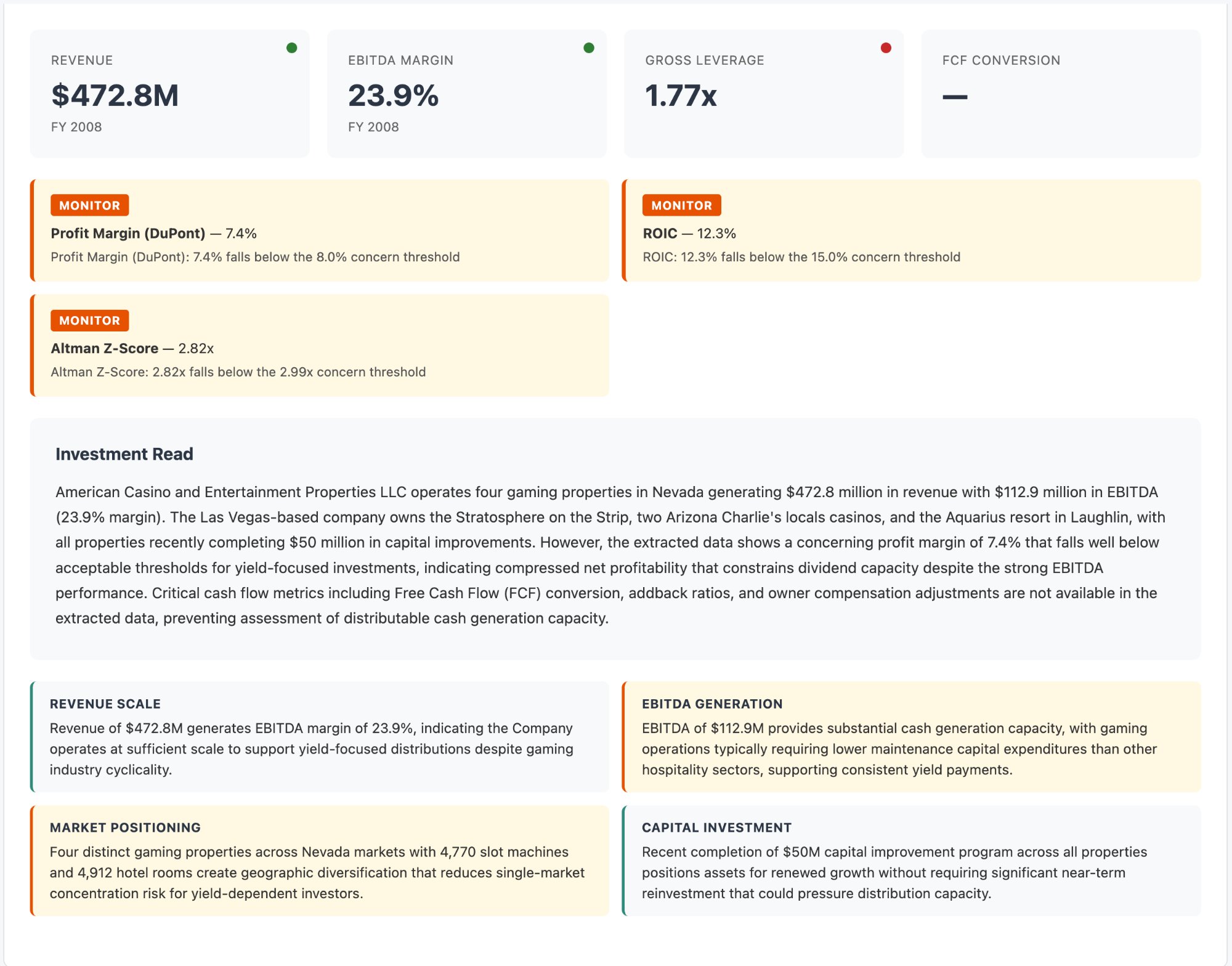
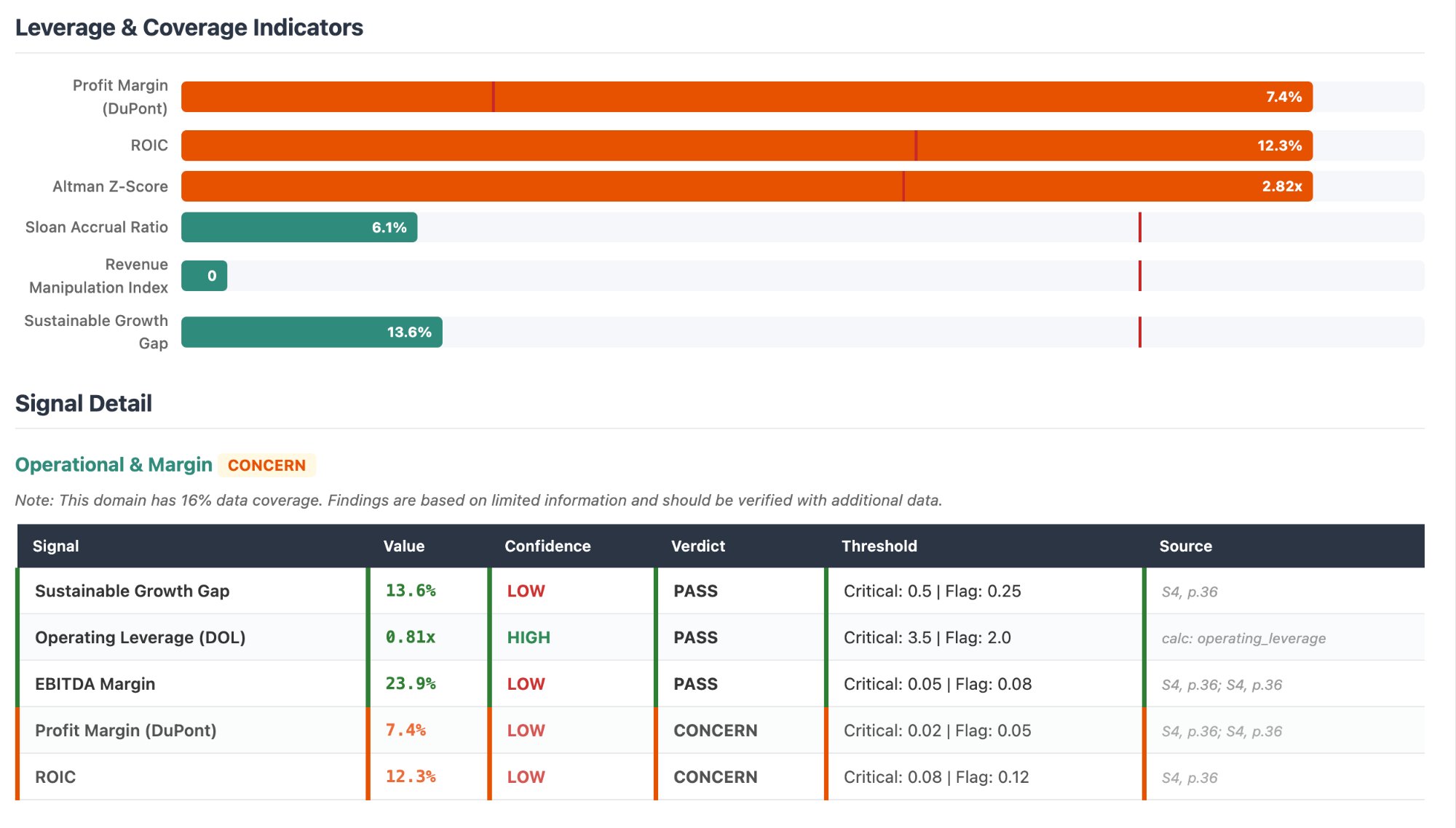
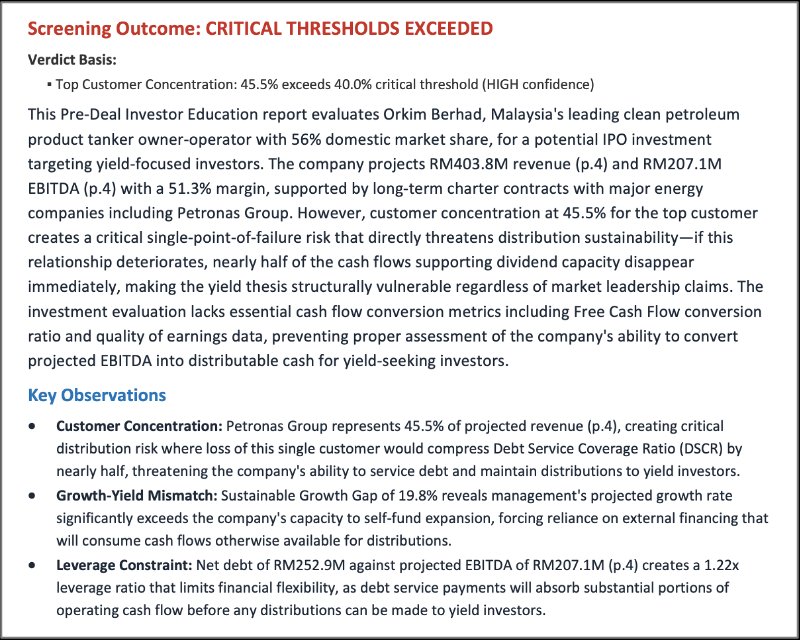
Real report sections from CIMCalc. Every number traces to a page in the source document. Every verdict includes the mechanism that triggered it.
Process
How It Works
Upload
Your financial document — prospectus, PDIE, annual report, CIM, institutional research, SEC 10-K/10-Q, investor presentation, debt memo, or business plan.
Declare
Your investment intent. CIMCalc supports yield acquisition, growth expansion, platform consolidation, distressed turnaround, strategic IP, talent acquisition, and regulatory arbitrage.
Receive
A structured screening report: a clear verdict (Pass, Monitor, Material, or Critical), domain-by-domain risk analysis across 9 categories, every conclusion traceable to the source document — plus prioritised verification questions that a deal professional should ask based on the specific risks found. The report doesn’t just tell you what’s wrong — it tells you what to ask next.
Capabilities
Key Capabilities
Use Cases
How Institutions Use CIMCalc
Pre-Investment Screening
Run any document through CIMCalc before committing analyst time — prospectuses, PDIEs, annual reports, institutional research. Surface earnings manipulation, governance red flags, and liquidity traps in hours, not weeks. For every investment backed, institutions review approximately 80 opportunities. CIMCalc compresses the time to a defensible "no" — preserving capital and analyst bandwidth for the deals that matter.
Portfolio Monitoring
Re-evaluate existing holdings against the original investment thesis. Has customer concentration increased? Has the margin profile degraded? The computation removes anchoring bias — the analyst who championed the buy does not grade their own homework. Research shows investors hold losing positions approximately 50% longer than winners, costing 3–6% annually in forgone returns.
Thesis Resolution
When two teams disagree on the same company — growth mandate versus income mandate — give each a verdict calibrated to their thesis. The data resolves the argument, not seniority. Same document, same extraction, different computation, different verdict.
Audience
Who It’s For
DocScreen: The Engine Behind CIMCalc
CIMCalc is built on DocScreen — a general-purpose document screening engine that can evaluate any document against any checklist. CIMCalc is DocScreen with the investment knowledge graph pre-loaded. For organisations with screening needs beyond investment due diligence — lending, procurement, compliance, insurance underwriting, legal review — DocScreen can be configured with custom criteria and thresholds.
See CIMCalc in Action
Request a demo using your own documents. You judge the output.